The Most Underrated Climate Tool in Malaysia Is Already in Your Pocket
When 2.2 million Malaysians set an electricity budget on their phones, something significant is happening — even if no one is calling it a climate intervention.
Climate action tends to conjure images of solar farms, offshore wind turbines, and policy summits in distant capitals. It does not typically conjure an alert on a smartphone telling a household in Subang Jaya that they are approaching their monthly electricity limit. Yet the latter may, in aggregate, be doing more measurable work on Malaysia’s emissions trajectory than many of the grander interventions that absorb the bulk of policy attention.
Internal analysis indicates that electricity consumption reductions associated with digital monitoring and energy management initiatives reached approximately 106 GWh, equivalent to an estimated avoidance of approximately 82,215 metric tonnes of CO₂ emissions — broadly comparable to the annual carbon absorption potential of approximately 4.5 million trees.
Eighty-two thousand tonnes. From an app feature. At a time when Malaysia’s energy sector is under intense scrutiny for rising emissions intensity and structural coal dependence, that number deserves to be read slowly and taken seriously. It will not single-handedly meet the country’s Nationally Determined Contribution. But it demonstrates, with operational data rather than modelling assumptions, that demand-side digital intervention works — and that its potential at greater scale has barely been touched.
The Behaviour Change That Went Unannounced
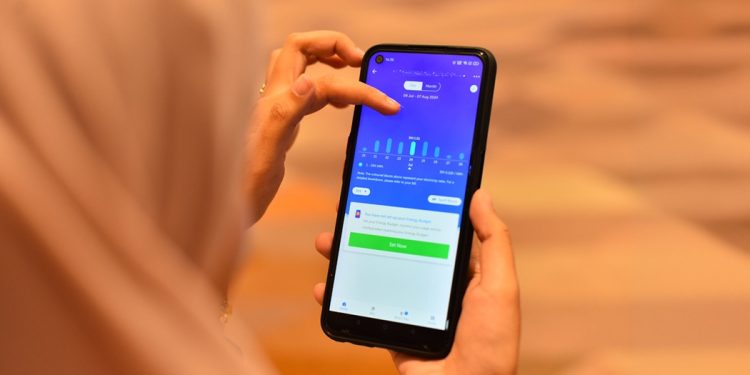
The Energy Budget function allows users to set monthly consumption thresholds and receive alerts when their usage approaches predefined limits. As at March 2026, more than 2.2 million users were utilising this feature.
Two point two million Malaysians have voluntarily elected to be told when they are using too much electricity. Think carefully about what that represents behaviourally. These are not customers responding to a regulatory mandate or a punitive tariff structure. They are individuals who downloaded an app, navigated to a feature, set a personal consumption ceiling, and opted into a notification system that holds them accountable to it.
In the language of behavioural economics, this is a nudge architecture of considerable sophistication. The feature does not restrict consumption. It does not impose penalties. It simply makes consumption visible — in real time, in the context of a self-defined goal — and trusts the user to respond. The fact that 2.2 million users have adopted it, and that the aggregate effect is measurable in the tens of thousands of tonnes of CO₂ avoided, is evidence that the trust is well placed.
This is how demand-side energy management actually works at scale. Not through top-down rationing or price shocks, but through the patient accumulation of individually small, collectively significant behavioural adjustments made by people who have been given the information and tools to make them. Malaysia has built that architecture. The question is how aggressively it is now prepared to build on it.
Awareness Is Necessary; It Is Not Sufficient
The ESG narrative is appropriately measured in its claims. These observations indicate that greater access to electricity usage information may support more informed energy consumption practices over time. The hedged language — “may support,” “over time” — reflects genuine epistemic caution, and it is the right instinct. Correlation between digital monitoring adoption and consumption reduction does not automatically establish causation, and attribution in energy management is complex.
But the directional signal is clear, and it aligns with decades of international evidence: when people can see their consumption in real time, relative to a budget or benchmark they care about, they tend to use less. The United Kingdom’s smart meter rollout, Germany’s energy efficiency programmes, and Australia’s demand response trials all converge on the same finding. Information, when delivered in the right format at the right moment, changes behaviour.
What myTNB has demonstrated is that this dynamic holds in the Malaysian context, across a culturally and economically diverse user base, without coercion and without the expensive in-home display infrastructure that early smart metering programmes required. A smartphone, a well-designed app, and a budget threshold. The cost-to-impact ratio of that intervention, compared with supply-side alternatives at equivalent emissions reduction, almost certainly makes it one of the most efficient climate tools in the national portfolio.
Almost certainly — because Malaysia has not done the rigorous cost-effectiveness analysis required to make that claim definitively. That analysis should be commissioned, and its findings should inform how energy efficiency and demand management are prioritised in the next iteration of the National Energy Transition Roadmap.
Green Electricity Tariff: A Quiet Innovation Deserving Louder Policy Support
As at March 2026, more than 8,400 renewable energy accounts have been registered through the platform via the Green Electricity Tariff, providing customers with an accessible option to participate in renewable energy programmes without requiring direct infrastructure investment.
Eight thousand four hundred accounts is a modest figure against the backdrop of 7.5 million myTNB users. It is tempting to read it as evidence of limited market interest in renewable energy participation among Malaysian consumers. That reading would almost certainly be wrong.
The more plausible explanation is that 8,400 accounts is what you get when a green tariff product is offered through a digital platform with minimal marketing, no visible public campaign, and no institutional framework that creates meaningful incentives for uptake. It is not a demand signal. It is a supply and awareness signal — specifically, that too few Malaysians know this option exists, and too few have been given a compelling reason to choose it.
The Green Electricity Tariff is, conceptually, exactly the kind of instrument that a middle-income country transitioning its energy mix needs. It allows households and businesses without the capital, the roof space, or the technical capacity for on-site solar to nonetheless contribute financially to renewable energy development. In markets where it has been actively promoted — in parts of Europe, the United States, and Australia — green tariff uptake has reached meaningful proportions of the customer base. Ten percent, twenty percent in some jurisdictions.
If Malaysia’s GET were to reach even five percent of myTNB’s active user base of 4.3 million, that would represent over 200,000 accounts providing a stable revenue signal for renewable energy investment. The infrastructure to reach those customers exists. What is missing is the combination of awareness, incentive design, and institutional ambition to deploy it.
The Energy Commission, the Ministry of Energy Transition and Water Transformation, and TNB should treat GET uptake as a policy target, not a passive commercial outcome. That means marketing investment, corporate procurement pathways, employer-facilitated enrolment schemes, and integration with broader sustainability reporting requirements for Malaysian businesses.
The Performance Honesty That Builds Trust
One of the more striking features of this ESG narrative — and it is worth noting because it is genuinely uncommon — is its willingness to publicly acknowledge technical shortcomings.
Feedback from application platforms and customer experience measurements continues to provide valuable insights into areas for improvement, including loading delays, system responsiveness and occasional issues related to payment processing and data updates. These inputs are systematically reviewed to identify recurring patterns, particularly during peak usage periods where higher traffic may affect application performance.
A corporate ESG publication that mentions loading delays and payment processing failures is not typical. The instinct in most institutional communications is to suppress operational friction and lead with achievement metrics. The fact that TNB’s narrative includes these acknowledgements — and describes the systematic process for addressing them — is a small but meaningful signal of institutional maturity.
It also matters for a practical reason. The 106 GWh of consumption reduction and the 82,215 tonnes of CO₂ avoided depend entirely on users actually engaging with the platform. An app that frustrates users with slow loading times or unreliable payment processing will lose those users — not to a competitor, but to apathy. The environmental case for maintaining high digital service standards is as real as the commercial one. Every user who abandons myTNB because the app lagged during peak hours is a unit of demand-side management potential that evaporates.
This is why the commitment to continuous improvement described in the ESG story is not boilerplate — it is climate infrastructure maintenance. It should be resourced accordingly.
The 106 GWh in Context — and What It Points To
Malaysia’s total electricity consumption is in the region of 170,000 GWh annually. The 106 GWh attributable to myTNB’s digital monitoring and energy management initiatives represents approximately 0.06 percent of that total. Stated that way, it sounds negligible.
But consider the trajectory. This outcome was achieved with 2.2 million Energy Budget users, out of a total active user base of 4.3 million, on a platform with 7.5 million registered users, in a country where the total electricity customer base is considerably larger still. The penetration of the most impactful features remains partial. The platform itself, despite its impressive scale, is not yet reaching all segments of the population with equal effectiveness. Smart meter integration, which would make usage data genuinely granular and real-time, is still rolling out.
Project forward from those conditions to a scenario where smart meters are universal, Energy Budget adoption reaches sixty or seventy percent of active users, GET enrolment reaches five percent of the customer base, and Time-of-Use tariff participation becomes the norm rather than the exception. The demand-side emissions impact does not grow linearly. It compounds. The 106 GWh of today could plausibly become ten or twenty times that figure within a decade, without adding a single solar panel or retiring a single coal unit — simply by enabling consumers to make better decisions about the electricity they already consume.
This is the prize that Malaysian energy policy has not yet fully articulated. Demand-side management through digital platforms is not a supplementary strategy. It is a core pillar of the energy transition that is currently receiving a fraction of the policy attention and institutional investment directed at supply-side measures.
What Needs to Change
Three shifts would unlock the full potential of what myTNB has built.
First, the government should establish a formal Demand-Side Management target within the National Energy Transition Roadmap, expressed in GWh of consumption reduction attributable to digital platform interventions. Without a target, there is no accountability, no dedicated budget, and no mechanism for course correction. The 106 GWh benchmark provides an excellent baseline from which to build.
Second, the Energy Commission should create a regulatory incentive structure that rewards TNB for measurable consumption reduction, not just for units delivered. The current regulatory framework, like most utility regulatory models, compensates TNB primarily based on electricity sales volumes. A utility that helps its customers use less electricity is, under this model, working against its own financial interests. Reforming that incentive structure — through mechanisms such as decoupled revenue models or explicit demand-side performance rewards — is essential if TNB is to be genuinely motivated to scale features like Energy Budget and GET rather than merely offering them.
Third, efforts going forward should focus on strengthening system performance, enhancing user experience and expanding features that support more informed decision-making — but this mandate needs to be accompanied by public commitment to specific feature enhancements, adoption targets, and reporting transparency. The evolution of myTNB from a connected platform to a genuinely empowering one requires more than continuous improvement cycles driven by app store feedback. It requires strategic intent, expressed in measurable commitments, and held accountable by public reporting.
The Citizen as Climate Actor
There is a philosophical dimension to what myTNB’s smarter energy features represent that goes beyond gigawatt-hours and carbon metrics. It is about the role of the ordinary citizen in the energy transition.
For most of the history of the electricity sector, the consumer has been exactly that — passive, consuming, largely irrelevant to the decisions that shape the system. Those decisions were made by engineers, regulators, politicians, and utility executives. The citizen paid the bill. Full stop.
The emergence of digital energy platforms disrupts that arrangement. When a Malaysian household sets an Energy Budget alert, monitors their real-time consumption against it, shifts their air conditioning schedule to off-peak hours under a Time-of-Use tariff, and pays a modest premium to ensure their electricity comes from renewable sources, they are no longer a passive recipient of an energy service. They are an active participant in a complex system — a system whose aggregate behaviour determines, in part, Malaysia’s emissions trajectory and climate commitments.
That participation is still nascent. It is still mediated through the relatively blunt instruments of budget alerts and tariff choices. But it is real, it is measurable, and it is growing. As these improvements take shape, myTNB is expected to continue supporting a more connected, responsive and sustainable energy ecosystem.
The citizen is ready. The platform is ready. What Malaysia needs now is a policy environment that treats the demand side of the energy transition with the same seriousness, the same investment, and the same ambition that it brings to the supply side.
The most underrated climate tool in Malaysia is already in 7.5 million pockets. It is time to use it properly.
The author writes on digital public infrastructure, energy policy, and Malaysian governance. Views expressed are the author’s own.
https://www.tnb.com.my/sustainability/esg-stories-mytnb-smarter-sustainable-energy/